I’ve spent more than two decades on the vendor side of Fortune 1000 IT staffing programs, first building out delivery at ObjectWin Technology and now advising firms through Skillpoint on how to keep their seat at the table.
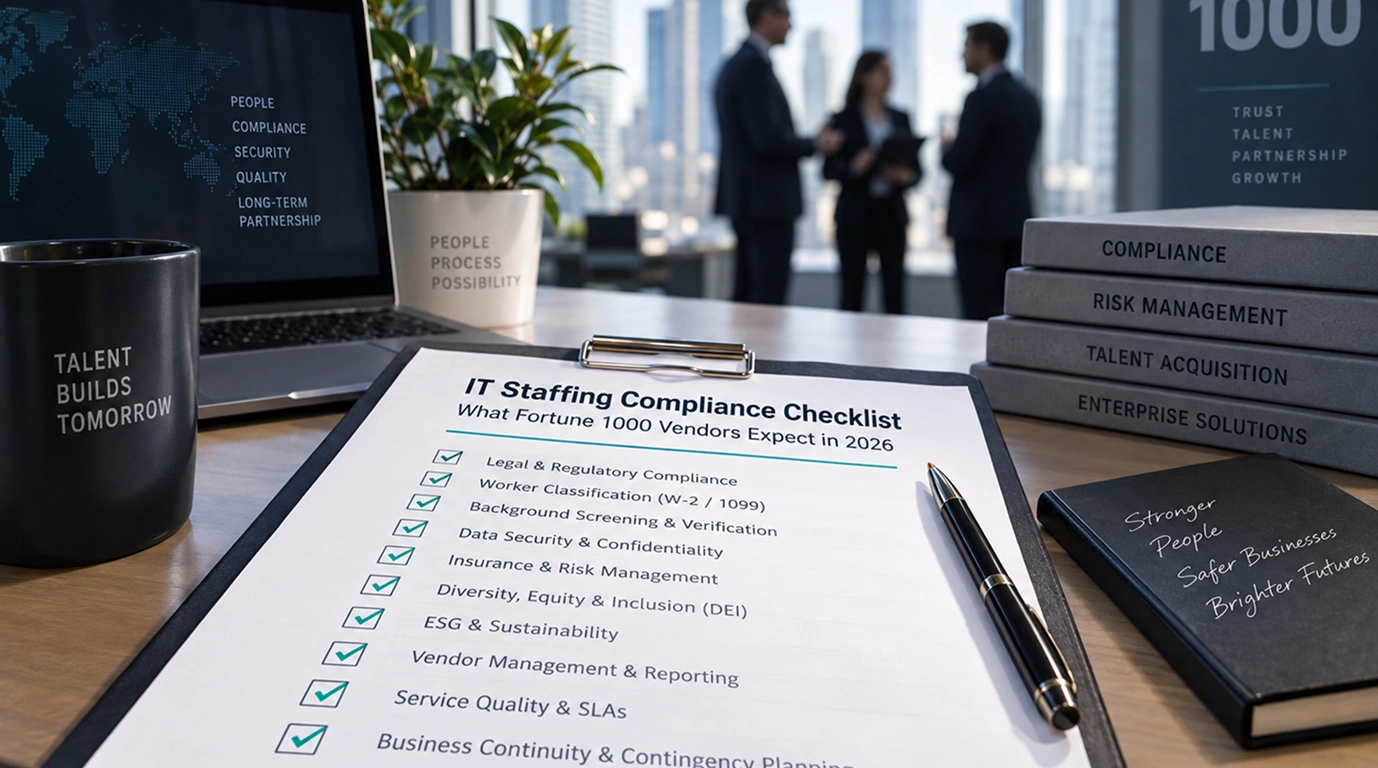
In 2026, compliance stopped being a once-a-year audit item. It’s built into every requisition, every VMS upload, every background check log. A vendor that treats compliance as paperwork loses requests to the vendor that treats it as infrastructure. Here’s the checklist I’d actually hand a staffing firm trying to earn or keep a place on a Fortune 1000 supplier list this year.
What “Compliant” Actually Means Inside a Fortune 1000 Program
Compliant means you can prove every claim your firm makes about a worker before that worker logs into a client system for the first time. It isn’t a general reputation for being careful, and it isn’t something a client takes on faith. Most large enterprises now run contingent labor through a managed service provider and a vendor management system, and that combination decides, long before you submit a candidate, what compliance looks like in your specific program.
The MSP configures which fields are mandatory, which documents must be uploaded, and how quickly you’re expected to respond to a new requisition. Miss a field and your submittal doesn’t just get flagged, it gets rejected before a hiring manager ever sees it. I wrote more about how one certification signals this kind of readiness in my post on CCWP certification, and the same logic applies across every compliance category below.
Worker Classification and Co-Employment Exposure
Classification is where I see vendors get burned the most, and 2026 has made it worse, not easier. The Department of Labor’s updated economic reality test is pushing HR teams to scrutinize 1099 and Corp-to-Corp arrangements far more closely, and a Fortune 1000 client will hold you, not themselves, accountable if a worker turns out to be misclassified.
Co-employment risk shows up when a client’s manager starts directing a contractor’s day-to-day work as though they were staff. This is the single gap I see most often in my advisory work at Skillpoint when reviewing a new client’s contingent workforce program.
Documentation to keep on file for every placement
- Who supervises the worker day to day
- Who owns the tools and equipment used
- A written scope-of-work statement, revisited when the role changes
Signs that a placement is drifting toward co-employment
- The client sets performance reviews or discipline directly
- Reporting lines run to a client manager with no vendor checkpoint
Background Screening, I-9, and E-Verify in 2026
Screening compliance isn’t about running a check once and moving on. It’s about your process holding up when someone actually audits it. I-9 enforcement got a lot tighter this year. Since March 2026, ICE has narrowed the form errors that still count as correctable technical mistakes, so things that used to be an easy fix, like a missing work authorization date or an incomplete Section 2 entry, can now trigger fines outright.
E-Verify is still voluntary for most private employers, but it’s mandatory for federal contractors, who have 30 days after a contract award to get enrolled. A handful of states have started stacking their own requirements on top of that federal baseline, too. If you’re serving Fortune 1000 clients, you need a standing internal I-9 audit process already in place, not something you throw together every time a client asks for proof. My own research into how unstructured screening at the junior level introduces risk applies just as much to documentation gaps as it does to bias.
Insurance, Financial Standing, and Program Registration
Every VMS program will ask for proof of coverage before your first candidate is even eligible for submission. Registration itself is often state-specific, so a firm operating across a dozen states may be maintaining a dozen separate files, each with its own renewal calendar.
None of this is glamorous work, but it’s the layer that determines whether your firm is even allowed to compete for a requisition. Details worth reviewing before your next VMS onboarding are outlined on my experience and credentials page.
Coverage of most Fortune 1000 programs requires
- General liability insurance
- Professional liability or errors and omissions coverage
- Workers’ compensation, at client-set minimum limits
- Proof of financial stability to fund payroll through the contract term
Data Security and AI Screening Tools Are Now Compliance Items
If your firm uses AI in any part of screening or matching, that tool is now part of your compliance profile, not just a line item in your tech stack. The EU is classifying recruiting AI as high risk, and states, including Colorado, have their own AI hiring rules taking effect this year.
A Fortune 1000 client will increasingly ask how your screening tools reach a decision and whether a human actually reviews the output before a candidate is advanced or rejected. This is exactly the kind of accountability gap I explore in my research and thought leadership works on structured, criteria-based hiring tools.
What clients now ask vendors to prove
- How the tool reaches a shortlisting or ranking decision
- What data was it trained or configured on
- Whether a human reviews the output before action is taken
- Documented retention, notice, and deletion policies for candidate data
Supplier Diversity Certification Still Opens Doors
Certification as a minority, women, veteran, or otherwise diverse-owned business remains one of the more reliable ways a staffing firm gets a first look from a Fortune 1000 procurement team. Most large enterprises have formal diverse spend targets, and many route a portion of contingent labor spend specifically through certified suppliers.
NMSDC for minority-owned firms and WBENC for women-owned firms are the two most recognized private certifications, and both require documented proof of at least 51 percent ownership, management, and control. Certification alone won’t win the business; delivery still has to hold up, but it consistently gets a supplier past a first screening gate that unregistered competitors never clear. It’s part of why I’ve built my own career around a certified minority-owned enterprise.
Pulling all of this together, most Fortune 1000 vendor rejections trace back to a handful of recurring gaps rather than anything exotic. The table below is the shortlist I walk new suppliers through before they submit their first candidate to a client program.
| Compliance Area | What the Program Typically Requires |
| Worker classification | Written documentation of supervision, scheduling, and equipment ownership |
| Background screening | FCRA-compliant process with a standing internal I-9 audit trail |
| E-Verify | Enrollment was confirmed where mandated by the client or the state |
| Insurance | Current certificates for general liability, E&O, and workers’ comp |
| Financial standing | Proof of ability to fund payroll through the contract term |
| State registration | Active registration in every state where workers are placed |
| Data security | Documented retention, notice, and deletion policies |
| AI screening tools | Explainable decision process with human review built in |
| Diversity certification | Current NMSDC, WBENC, or equivalent documentation on file |
Why Multi-State Programs Break Vendors Who Aren’t Ready
Every additional state a vendor operates in multiplies the compliance surface, not just the paperwork volume. A firm placing contractors in California, Illinois, and Colorado is effectively running three separate compliance programs under one roof, since ban-the-box timing, background check disclosure rules, and AI hiring restrictions all vary by state and change independently of each other.
What works as policy in one state can be an outright violation in another. I saw this same pattern play out while scaling programs across the United States, Canada, and India, which I touch on in my experience with global workforce delivery.
Where state rules diverge most often
- Timing of background check disclosures and ban-the-box rules
- AI hiring restrictions and required candidate notices
- Data privacy and retention obligations
- State-specific vendor registration and renewal deadlines
The Bottom Line for Vendors Heading Into 2026
If I were advising a staffing firm on where to start, I’d begin with the internal audit, not the client relationship. Pull your last twenty placements and check classification documentation, I-9 records, and insurance certificates against what a VMS would actually require today. Most gaps surface almost immediately once you look.
From there, build one compliance framework that every state-specific requirement gets layered onto, rather than rebuilding your process client by client. Compliance won’t win you a contract on its own, but in 2026, it’s become the baseline that decides whether your firm is even in the room to compete for one. If you want a second set of eyes on where your program stands, reach out directly and let’s talk it through.
FAQs
1. What does IT staffing compliance mean for a Fortune 1000 vendor?
It means being able to prove, with documentation, that every placed worker was properly classified, screened, and insured before starting. Fortune 1000 clients verify this through MSP and VMS requirements rather than trusting a vendor’s word, so proof has to exist in writing before a candidate is even submitted.
2. Is E-Verify mandatory for IT staffing agencies in 2026?
Not for most private employers, it’s still optional there. But federal contractors have to use it, and they need to enroll within 30 days of getting the contract. Add in the states now writing their own E-Verify rules, and where you’re placing workers ends up deciding what’s required.
3. What insurance does a staffing vendor need for enterprise clients?
Most Fortune 1000 VMS programs require general liability, professional liability or errors and omissions, and workers’ compensation coverage, with minimum limits set by the client. Proof is typically uploaded directly into the vendor management system before a supplier is eligible to submit candidates.
4. How does worker misclassification create risk for staffing firms?
Call a contractor a 1099 worker when the job actually functions like employment, and you’re exposed to back taxes, penalties, and legal trouble. The DOL’s 2026 economic reality test has sharpened this scrutiny, and clients usually push accountability back onto the staffing firm, not themselves.
5. What is co-employment risk in IT staffing?
Co-employment risk arises when a client’s manager directs a contractor’s daily work as though they were a direct employee, blurring the legal line between client and staffing firm. Vendors manage this by documenting supervision and the scope of work in writing at the start of every assignment.
6. Do AI screening tools need to be disclosed to enterprise clients?
More and more, yes. Colorado already regulates AI in hiring, and the EU treats recruiting AI as high-risk. Fortune 1000 clients are starting to ask how your screening tools actually make decisions, and whether a human checks the output before a candidate moves forward.
7. How does supplier diversity certification help a staffing firm win Fortune 1000 contracts?
It gets your firm in front of procurement teams that have real diverse-spend targets to hit. NMSDC, WBENC, or an equivalent certification won’t replace strong delivery, but it consistently opens doors that uncertified competitors just don’t get access to.
8. What changed with I-9 compliance in 2026?
ICE tightened the rules in March 2026, narrowing which I-9 errors still count as fixable technical mistakes during an audit. Things that used to be easy corrections, like a missing work authorization date, can now trigger fines outright, which makes internal audits more important than ever.
9. How many states can a staffing vendor operate in before compliance becomes unmanageable?
There’s no fixed number, but risk rises with every state added, since screening, disclosure, and AI hiring rules vary independently by jurisdiction. Vendors who build one internal compliance framework and layer state rules onto it tend to scale far more cleanly than those managing each state separately.