“The only sustainable competitive advantage is an organization’s ability to learn faster than the competition.” — Peter Senge.
If there’s one thing that two decades in IT staffing have taught me, it’s that learning, not luck or tech, separates firms that survive from those that thrive.
Hiring has become slower, noisier, and riskier. In 2025, the average time-to-hire climbed noticeably (roughly a 24% increase in several recruiting benchmarks), and the contingent workforce now represents a sizable portion of enterprise labor, meaning the margin for error is smaller, and the consequences of failed change are bigger.
I’ve seen teams pour money into tools while the process around those tools stayed the same: more dashboards, same handoff failures, same missed SLAs. That’s why I wrote this post. I’ll walk through a practical framework for turning recruiting know-how into repeatable capability, based on change-management research and proven in IT staffing delivery.
You’ll get a crisp problem map, four research-backed frameworks I use to diagnose and design change, and a five-step tactical playbook you can pilot this month to protect fill rates while you improve quality. No academic theory detached from the shop floor, just practical steps that actually move the needle.
Why Organizational Change Matters for Staffing Firms
Staffing work is a system. Sourcing, screening, onboarding, client relationship management, and delivery all feed into one another. When a single part breaks, slow screening, inconsistent onboarding, or poor feedback loops ripple across fill rates, client satisfaction, and margin.
Two recent industry patterns make this especially urgent. First, hiring processes are getting longer and heavier; hiring teams now conduct more interviews per hire, and the average time-to-hire has risen significantly, one 2025 recruiting benchmark found a 24% increase in average time to hire (from 33 to 41 days), driven largely by more touchpoints and more stakeholders in the process.
Second, the contingent workforce is no longer marginal; a substantial share of work in many markets is nonpermanent. Estimates and industry analyses in 2025 commonly place the contingent segment as a major portion of the labor market (often cited in the 30–40% range for the U.S. in contemporary industry summaries), which makes robust change-capability essential if organizations and their staffing partners are to manage risk and quality across diverse workforce types.
That’s why organizational change matters here!
The fastest way to improve performance is to change the system that produces work, not just to hire faster or buy another tool. Firms that treat change as an ongoing capability (not a one-off project) reduce time-to-fill, increase candidate quality, and protect client SLAs during transitions. In short, change readiness is a competitive advantage for staffing firms and for the clients who buy from them.
EdD vs MBA: Different Mindsets, Different Tools
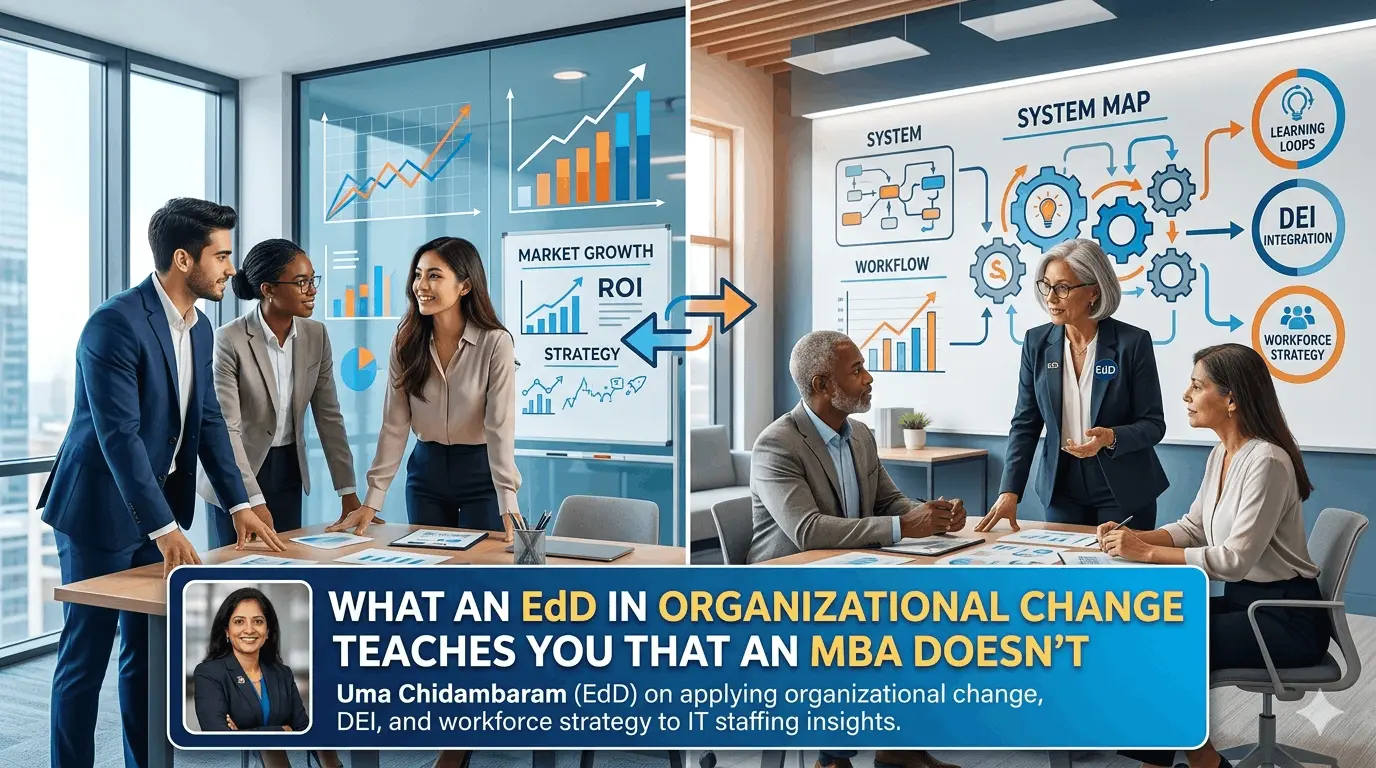
Over the years, I’ve had the opportunity to look at organizations through two very different lenses. One is the practitioner’s lens focused on speed, growth, and measurable business outcomes. The other is the scholar’s lens focused on systems, learning, and how change actually takes hold inside an organization. Both perspectives are valuable, but they solve different kinds of problems.
| Aspect | MBA Lens | EdD Lens |
| Core Mindset | Market, customers, growth — how do we win and scale? | Systems, behavior, learning — how will the organization adapt and sustain change? |
| Key Question | “Who is the customer and what’s the unit economics?” | “How will the system respond when we change this part?” |
| Typical Tools | Go-to-market playbooks, pricing models, financial KPIs, sales funnel analytics. | Systems mapping, implementation science, learning loops, pilot designs, qualitative diagnosis. |
| Measures of Success | Revenue growth, margin, client acquisition, market share. | Leading indicators, behavior change, time-to-proficiency, repeatable outcomes. |
| Impact on Staffing | Builds scalable sales engines, clarifies pricing, and commercial strategy. | Converts recruiter tacit knowledge into playbooks, reduces rework, and protects SLAs during change. |
| When to Lean on It | Launching new service lines, scaling quickly, fundraising, or pricing decisions. | Fixing chronic delivery issues, embedding new practices, improving quality and retention. |
| Typical Output | Financial model, target segments, growth roadmap. | Pilot program, documented playbooks, measurement dashboards for behaviors. |
In practice, strong staffing organizations need both perspectives. The MBA lens helps you grow and compete in the market. The EdD lens ensures the organization can actually absorb that growth without breaking delivery. When those two mindsets work together, scaling a staffing business stops being a gamble and becomes a repeatable capability.
Four Research-Backed Frameworks an Edd Brings to Staffing
Below are four practical frameworks I use when I’m trying to move a staffing organization from reactive to change-ready. Each one is grounded in implementation science and learning organization principles, translated for the realities of staffing delivery.
1. System Diagnosis: Seeing Interdependent Processes, Not Just Roles
Most staffing leaders look at roles and metrics in isolation; recruiter A has lower fill rates, or time-to-fill rose this month.
- System diagnosis asks you to map the flow end-to-end: sourcing → screening → interviewing → onboarding → client feedback.
Where are the delays? Which handoffs create rework? This level of mapping surfaces hidden choke points and the leverage points where small changes produce outsized impact.
Quick actions:Draw a simple process map with your team and annotate where quality loss happens; track handoff metrics (e.g., percent of screened candidates accepted by hiring managers).
2. Learning Organization Design: Converting Tacit Recruiter Expertise Into Organizational Capability
Recruiters develop incredible tacit knowledge of how to read an interview, what messaging works for a niche, and which clients prefer certain skill profiles. The trick is to capture that into the organization, so it isn’t lost when someone leaves.
There’s real evidence that organizations that invest in learning and career development see outsized benefits:
LinkedIn’s 2025 Workplace Learning research shows that organizations identified as “career development champions” report higher confidence in their ability to attract and retain talent and are more likely to be adopting generative AI rapidly, indicators that learning-focused firms are better positioned for change and competitive advantage.
Practical moves: Short structured debriefs after placements (3 questions: what worked, what didn’t, what to try next), shared playbooks for niche hiring channels, and a small knowledge base with quick micro-guides for tricky roles.
3. Change Intervention Design: Piloting, Iterative Evaluation, and Sustaining Gains
Change rarely works if you flip everything at once. Design small pilots that are measurable and low-risk, evaluate quickly, and iterate.
- Use Plan-Do-Study-Act cycles: plan a focused change, run it with a small team, study the results with meaningful metrics, then act (scale or revise).
A good pilot includes a clear hypothesis, a short timeframe (4–8 weeks), and agreed evaluation criteria tied to client and delivery outcomes.
4. Measurement for Behavior Change: Beyond Output Metrics to Leading Indicators
Counting placements is necessary, but not sufficient. To drive behavior, measure the leading indicators that predict outcomes:
- Time-to-proficiency for new recruiters
- Candidate quality scores in the first 30 days
- Client feedback velocity
Those measures encourage the right behaviors (coaching, knowledge sharing, timely client check-ins) before the outputs move.
Example metrics:Percent of new hires hitting quota at 60 days, ratio of quality placements to total submittals, average time from candidate acceptance to first day.
How These Frameworks Apply to IT Staffing
Translating theory into staffing specifics is where the rubber meets the road. Below, I map the four frameworks to typical IT staffing workflows:
- Diagnosing the recruitment delivery system: Start by mapping the candidate journey from sourcing to placement. Identify where candidates drop out, where interviews are delayed, and how feedback cycles work. Often, the largest gains come from reducing feedback latency between hiring managers and recruiters; a 24–48 hour improvement in feedback can cut time-to-fill dramatically.
- Turning recruiter learning into repeatable processes (onboarding, playbooks, knowledge capture): Create short playbooks for critical roles (e.g., mid-level Java developer, AWS cloud engineer) that include the client’s non-negotiables, sample interview questions, red flags, and market-rate expectations. Pair new recruiters with brief shadowing and a 30-day proficiency checklist so tacit knowledge becomes visible and teachable.
- Designing change to protect delivery metrics (how to pilot without losing fill rates): If you pilot a new screening process, run it with a subset of non-critical roles or a single client to limit risk.
Set guardrails: maintain your historical fill-rate baseline and define trigger points to revert if performance dips. That way, you learn without harming client relationships.
Track how quickly new recruiters reach expected submission volumes and how early client feedback predicts long-term satisfaction. Use short surveys to capture hiring manager sentiment within the first two weeks of a placement that early signal often predicts retention and repeat business.
Real-World Example: Organizational Change in a Staffing Organization
In my role as an executive leader at ObjectWin Technology, I’ve helped build go-to-market strategies, introduce offshore delivery models, and improve operational performance across staffing teams. My work in the industry has also been recognized through the Global Power 150 Women in Staffing, which highlights leaders shaping the future of workforce solutions.
Challenge
During one engagement, a mid-market enterprise client was scaling a major IT initiative and asked us to rapidly increase contingent workforce delivery while maintaining strong fill rates and candidate quality. Internally, we saw clear variability across teams. Some consistently met client SLAs, while others struggled with recruiter–sourcer handoffs, inconsistent candidate preparation, and slower interview cycles.
The result was uneven delivery performance and unnecessary friction in the hiring process.
Intervention
Using a systems-thinking approach to diagnose the delivery workflow, we ran a six-week pilot focused on three targeted changes:
Standardized handoffs
Sourcers used a short structured briefing template when passing candidate profiles to recruiters, capturing key client expectations, technical signals, and risk flags.
Candidate readiness calls
Recruiters added a brief pre-interview alignment call with candidates to confirm expectations, clarify role requirements, and address gaps before interviews.
Faster feedback loops
Hiring managers committed to structured feedback within 48 hours after interviews, reducing delays and improving recruiter calibration.We tracked several operational indicators during the pilot, including feedback latency, interview scheduling speed, and interview-to-offer conversion.
Outcome
Within six weeks, the pilot produced measurable improvements:
- Interview scheduling time decreased by 32%
- Interview-to-offer conversion increased from 1:7 to 1:4
- Hiring manager feedback latency dropped from ~5 days to under 48 hours
- Overall fill rate improved by 18% across participating roles
Equally important, hiring managers reported stronger candidate alignment and fewer mismatched submissions. Because the process changes were simple and repeatable, we documented them into internal playbooks and incorporated them into recruiter onboarding so the improvements could scale across teams.
Why This Example Matters
Operational improvement in staffing rarely comes from large, disruptive transformations. More often, it comes from diagnosing where the system breaks down, piloting small targeted interventions, measuring what actually improves outcomes, and then scaling those practices across the organization.
5-Step Tactical Playbook for CHROs & Staffing Leaders
Below is an operational playbook you can start this month. Each step is short, tactical, and measurable.
Step 1: Map the system and identify choke points (include 2 micro-actions)
Micro-actions:
- Run a 1-hour mapping workshop with sourcing, recruitment, and account teams to sketch the end-to-end flow.
- Choose two handoff metrics to track for the next 30 days (e.g., time from submittal to client feedback; percent of screened candidates accepted for interviews).
Step 2: Create learning loops (micro-training + knowledge capture templates)
Micro-actions:
- Implement 10-minute micro-training sessions twice a week where recruiters share one “what worked” tactic.
- Create a one-page playbook template for each high-volume role and store it in a shared knowledge base.
Step 3: Pilot low-risk interventions with rapid evaluation (how long, what to measure)
Guidance:
- Pilot length: 4–8 weeks.
- What to measure: leading indicators (feedback latency, interview-to-offer conversion) and one business outcome (client satisfaction or fill rate).
- Evaluation: run a quick weekly dashboard and a short retrospective at the pilot end to decide next steps.
Step 4: Scale using playbooks and role-based KPIs (who owns what)
Actions:
- Assign owners for each playbook (senior recruiter or team lead) responsible for updates and training.
- Tie one KPI to each role that supports the playbook (e.g., sourcers measured on interview conversion rate, recruiters on first-90-day retention).
Step 5: Embed continuous measurement & governance (quarterly reviews + triggers)
Actions:
- Hold a quarterly “health-check” meeting that reviews lead indicators and triggers remediation if any metric drops below the threshold.
- Publish a short quarterly lessons-learned memo for the firm, so improvements spread laterally.
How This Plays Out in Global and Regional Enterprise Markets
Regional markets always have their own dynamics, procurement expectations, talent availability, and supplier diversity priorities that can vary significantly from one region to another. In many enterprise environments, organizations are increasingly looking for staffing partners who can demonstrate not just delivery capability, but also operational maturity and adaptability.
That means showing how your organization manages change, whether it’s scaling contingent workforce programs, adapting recruitment strategies to new technologies, or improving delivery systems without disrupting client outcomes.
In my experience working with enterprise clients, the firms that stand out are the ones that can clearly articulate how their systems work, how they improve them, and how those improvements translate into better outcomes for clients and candidates alike.