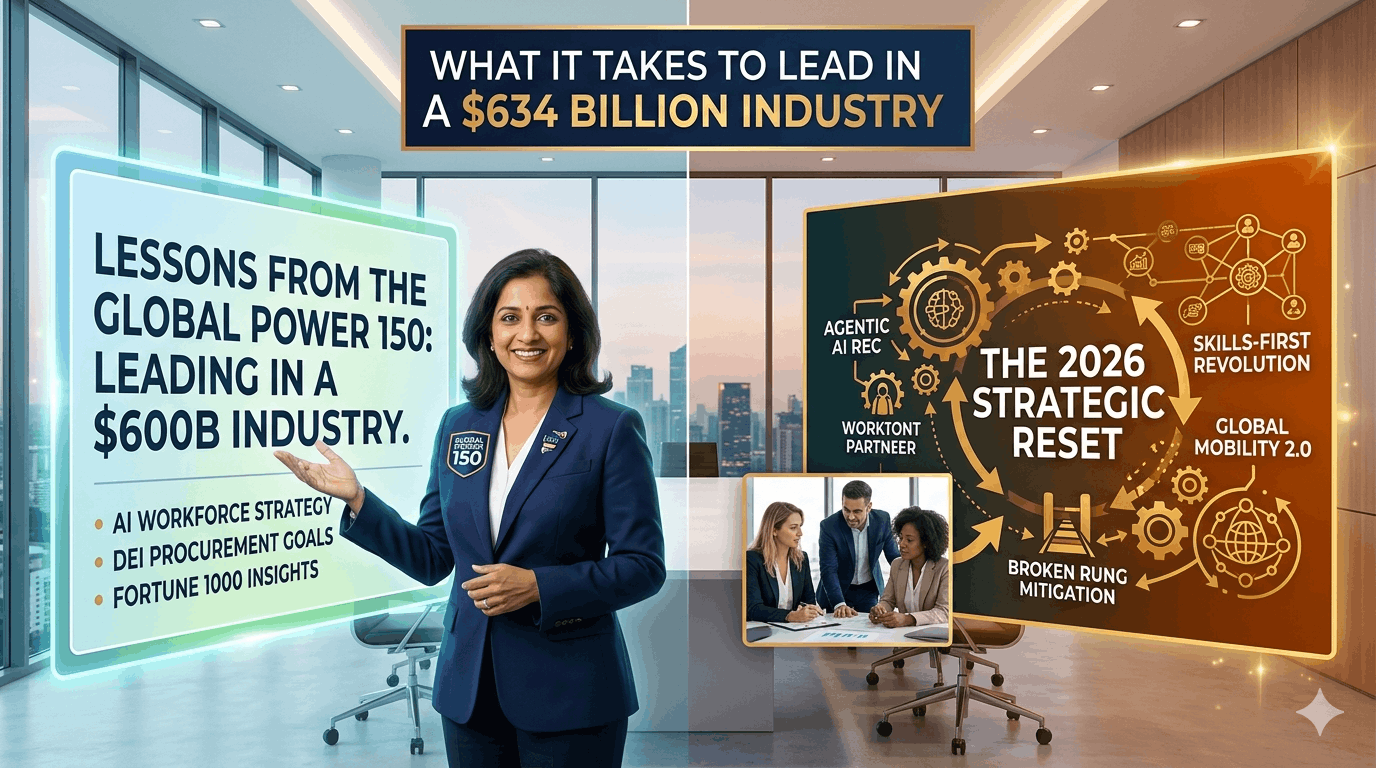
Being named to the SIA Global Power 150 Women in Staffing list is a humbling milestone, but more than the recognition, it provides a unique vantage point. Standing at the intersection of a $600 billion global industry and a rapidly growing technological landscape, I have realized that leadership in 2026 is not about who has the biggest database anymore. It is about who can navigate the scholar practitioner divide.
The staffing world has shifted from a transactional fill the seat model to a high stakes consulting environment. Whether I am drawing on my EdD research from Baylor or my executive education at Harvard and Rice, I see a clear pattern. The leaders winning today are those who treat human capital with the same rigorous strategy as financial capital. In this blog, I want to pull back the curtain on what it truly takes to lead in this massive, volatile, and deeply rewarding industry.
The $600 Billion Question: Why Now?
We are not just in a recovery phase in 2026; we are in a total restructuring. Current global forecasts place the staffing and recruitment market at a staggering $634 billion. The United States market alone is projected to reach nearly $195 billion this year. However, these numbers hide a complex reality. We are navigating an economic environment where hiring is not just about volume. It is about precision.
For me, leading at ObjectWin Technology has meant moving beyond the traditional IT staffing lens. We are now strategic partners for Fortune 1000 companies that are desperate for agility. When I talk to CHROs today, they are not asking for ten resumes. They are asking how to build a change ready culture that can survive the next technological pivot.
This requires a level of executive intimacy that goes far beyond a standard vendor relationship. It requires understanding the internal organizational change theories that I studied during my doctoral program and applying them to real world talent gaps.
The Three Pillars of Modern Staffing Leadership
Through my journey from an account manager to Executive Vice President, I have identified three core pillars that define a Power 150 leader in today’s market. These are not just theories. They are the daily bread and butter of how we keep our clients ahead of the curve.
1. Specialization at Scale (The “Blue Ocean” Strategy)
In a market this large, generalists are becoming a commodity. The real value lies in Specialization at Scale. This means having deep, niche expertise in areas like AI driven talent acquisition or DEI compliant staffing while maintaining the infrastructure to support global enterprises. If you try to be everything to everyone, you end up being nothing to the clients who matter most.
| Leadership Trait | Old Model (Pre-2024) | New Model (2026) |
| Sourcing Strategy | Keyword matching via ATS | AI-Agentic predictive matching |
| Value Proposition | Speed and Volume | Quality of Hire and ROI |
| Client Relationship | Vendor / Supplier | Strategic Consultant / Partner |
| Credentialing | Resume-based | Skills-validated (Degree-Optional) |
2. The Scholar-Practitioner Edge
This is where my EdD in Learning and Organizational Change from Baylor University comes into play. Most staffing leaders focus on the what, which is filling roles. The best leaders focus on the how, which is how organizations learn and adapt. In 2026, if your staffing firm is not behaving like a learning organization, you are already falling behind. We must be students of our clients’ cultures before we can be providers of their talent.
3. Ethical AI Integration
We have moved past the AI hype of 2024. In 2026, we are managing Agentic AI, which consists of digital teammates that handle the transactional grunt work. Leadership now involves hyper automation orchestration. For example, at ObjectWin, we do not just use AI to find candidates. We use it to audit our own processes for bias. This ensures that our diversity spend for Fortune 1000 clients is not just a number on a spreadsheet but a verified, ethical outcome.
Leading through the “Broken Rung”: A Personal Mission
One of the most significant parts of being on the Global Power 150 list is the responsibility to the next generation of women. I am particularly focused on South Asian women looking to break into the C-Suite. The data from early 2026 is a wake up call. Women still make up only 29 percent of C-Suite roles in corporate America. The broken rung, which is that first step up to the manager level, is still a major hurdle.
For every 100 men promoted to manager, only 93 women move up. When you look at women of color, that number drops to 74. This is where mentorship must evolve into advocacy. I do not just give advice to the women I mentor, I provide access. Sponsorship is significantly more effective for promotions than simple mentorship. We need to close that gap by putting our own reputation on the line for the talent we believe in.
How I Approach Mentorship
- Advocacy over Mentorship: I don’t just give advice; I provide access. Sponsorship is 2.0x more effective for men’s promotions than women’s. We need to close that gap.
- Building Resilience: Drawing from my days as a state-level Table Tennis champion, I teach my mentees that business, like sports, is about the “recovery.” It’s not about never losing a deal; it’s about how fast you reset for the next serve.
- Cultural Fluency: Navigating three different countries throughout my career taught me that leadership looks different in Bangalore than it does in Houston. I help women bridge these cultural “invisible barriers” to reach the boardroom.
Case Study: The “ObjectWin” Playbook for Fortune 1000 Diversity
A few years ago, we worked with a major financial services client that was struggling to meet their Tier 1 diversity spend goals. They had the budget, but they didn’t have the pipeline. I applied the principles from my Harvard executive education on Sales & Strategy Alignment. We didn’t just give them a list of diverse candidates. Instead, we redesigned their entire contingent workforce intake process.
The Result:
- 30% Increase in diverse hires within 12 months.
- 15% Reduction in cost-per-hire through AI-automated compliance.
- Gold Standard Status: They are now a case study for minority-owned staffing firm partnerships.
This is the power of a minority-owned firm that doesn’t just “do” staffing but “designs” workforce solutions.
Looking Ahead: The 2026 Strategic Reset
As we move through 2026, the staffing industry faces what I call a Strategic Reset. The Great Stay, where employee retention is high and churn is low, means staffing firms must provide more than just people. We must provide workforce intelligence.
Key Trends to Watch:
- The Skills-First Revolution: 92% of employers now prioritize validated skills over degrees. Our job is to be the “validators.”
- Agentic Recruitment: Recruiters will spend 70% less time on scheduling and 100% more time on “relationship-based interviewing” to separate AI-generated resumes from true talent.
- Global Mobility 2.0: With H-1B fees rising and new rules in place, nearshoring and strategic offshoring (like our India operations) are no longer “cost-savers”, they are “talent-expanders.”
This shift is actually a massive opportunity for equity. It allows talent from non-traditional backgrounds to compete on a level playing field. For a leader in the Power 150, this is the most exciting development of the decade. We are finally moving toward a meritocracy that is powered by data rather than just networks.
The Future of Human Connection in an AI World
As we look toward the end of 2026 and into 2027, the biggest challenge for staffing leaders will be maintaining the human element. With AI handling the sourcing, the screening, and the scheduling, what is left for the human recruiter?
The answer is empathy and negotiation. AI can tell you if a candidate is qualified, but it cannot tell you if they are ready for the emotional challenge of a leadership role. It cannot sit down with a CHRO and understand the unwritten rules of their boardroom.
My Rice Business RAMP alumni experience taught me that the most successful leaders are those who can blend high tech with high touch. We use the most advanced tools available, but we never let the tool replace the conversation. At the end of every placement is a person whose life and career are being impacted. That is a responsibility I never take lightly.
Summary: The Path Forward for Workforce Leaders
Leading in a $600 billion industry is a marathon, not a sprint. It requires a constant balancing act between the data driven demands of the market and the human needs of the workforce. Whether you are a woman starting her career in staffing or an executive at a Fortune 1000 company, the lessons are the same.
Stay curious. Lean into your unique credentials. Do not be afraid to be the scholar in a room full of practitioners. When we combine academic rigor with operational excellence, we do not just fill jobs. We change the way the world works.
I am honored to be part of the Global Power 150, but I am even more excited about what we will build next. The future of work is not something that happens to us. It is something we create together.